
Trace Former Webster County Owners Transfer by Transfer
A backward chain starts with one deed you already know. It must belong to the land in question. Each row in such a chain is a step in the search. It is not a claim about a specific parcel. Write down the newest grantee, the prior grantor, the instrument type, its filing date, and the land description from the deed records. Then treat that grantor as the next grantee and search again.
| Transfer date | Grantor to grantee | Deed type | Book / page |
|---|---|---|---|
| Newest filing | Prior owner to current grantee | Recorded conveyance | Copy exact reference |
| Earlier filing | Earlier grantor to prior owner | Warranty, quitclaim, fiduciary, or other deed | Copy exact reference |
| Earlier book era | Repeat with matching land | Physical or microfilmed instrument | Volume and page |
The legal description controls everything. A trustee, an administrator, or a shared surname can turn up on deeds that have nothing to do with your parcel. No one joins the chain until the deed covers the same lot, tract, or predecessor parcel.
Use Webster County's Grantor-Grantee Controls in Reverse
The Delta deed index searches parties last-name-first, with separate controls for grantors and grantees. Start with the current owner as grantee to find the incoming deed. On the next pass, search the prior grantor as grantee instead. If the results come back too broad, narrow them by filing date, instrument type, book range, subdivision and lot, or section-township-range. The official index page displays these backward-search keys. A visitor can recognize them before submitting a query.
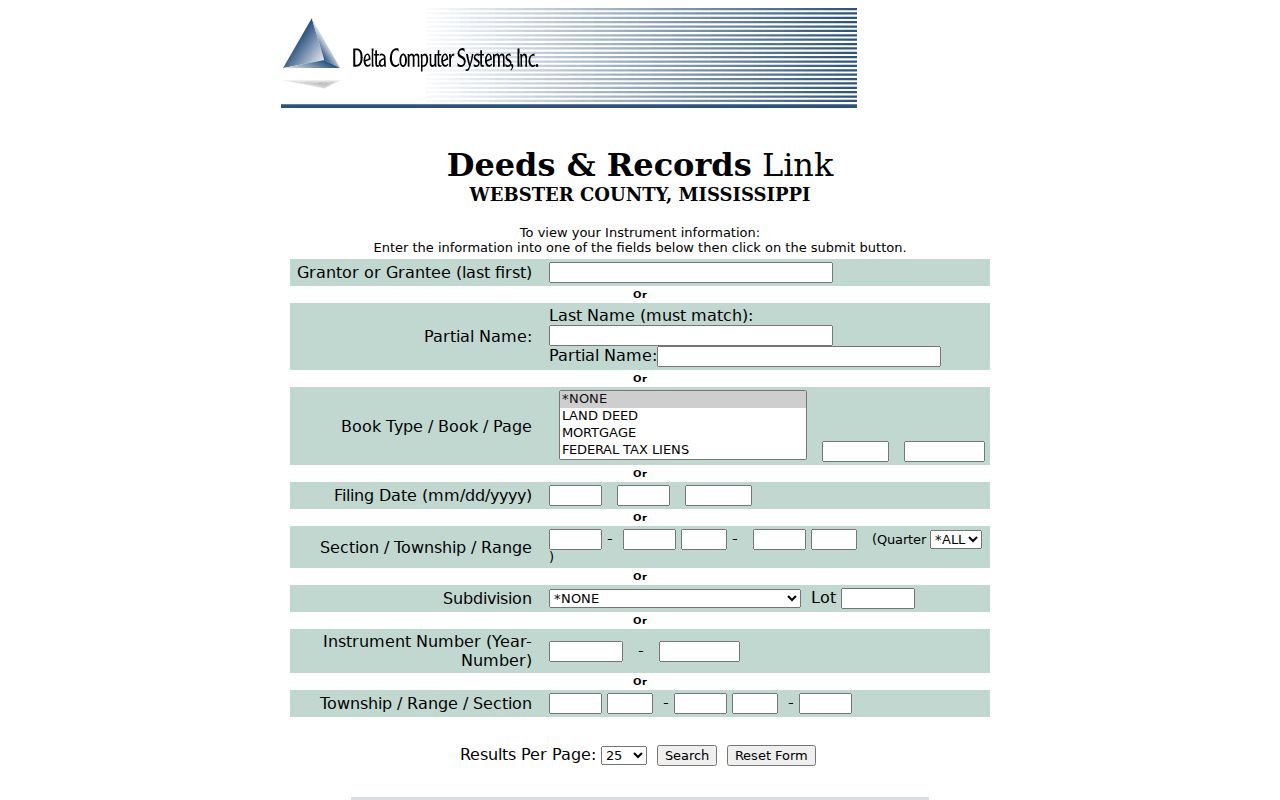
Separate controls for party, book, date, subdivision, instrument, and land description let a former-owner trail be narrowed without depending on one exact name.
| Index control | Backward-chain use | Caution |
|---|---|---|
| Include grantees | Find how a prior owner acquired the land | Name must match the description |
| Include grantors | Find a later transfer out | Do not skip intervening deeds |
| Subdivision / lot | Hold a platted parcel steady | Use the index's exact spelling |
| Section / township / range | Hold rural acreage steady | Compare quarter and acreage |
| Instrument range | Narrow an era | Online cutoff is not published |
The form's “Or” layout treats its primary keys as alternatives. Pick the strongest known key first, then use the refinement panel instead of assuming every field combines. Save any result before changing the query.
Reconstruct a Webster County Deed Chain Backward
Think of the chain as a repeated test of evidence. It begins with the newest deed confirmed for the parcel and moves back only when the next instrument describes the same land. A tax-roll name can supply the opening clue. The recorded conveyance, though, supplies the parties and the historic book-and-page reference.
- Find the newest deed with the present party as grantee and copy its complete legal description.
- Record the grantor, filing date, deed type, instrument number, and book/page.
- Search that grantor as a grantee and locate the instrument by which the same interest was acquired.
- Repeat while checking acreage, exceptions, prior-instrument references, and parcel changes.
- When the online trail stops, continue at the Clerk or through the MDAH catalog and microfilm route.
- Grantor
- The party conveying the stated interest.
- Grantee
- The party receiving the stated interest.
- Chain of title
- The linked sequence of instruments affecting the same land.
- Reverse index
- An index organized to find conveyances through the grantee side of the record.
- Warranty and quitclaim
- Different deed forms; neither label alone proves the chain is complete.
Keep Webster County's Old Land Description in View
Modern street text is often the weakest historic key. Webster's deed form supports subdivision and lot for platted land. Section-township-range with quarter choices covers rural land. Carry both the old description and the current parcel number. If acreage shifts between deeds, look for a partial conveyance, a split, a merger, or a correction. It may instead be an older tract from which the parcel was carved.
The subdivision dropdown keeps the language found in the local records. Its entries include Magnolia Heights Parts 1 through 4, Southland Park Parts 1 through 3, Mathiston Original, North Maben, cemetery entries, and surveys. It even lists “indefinite” descriptions. It preserves the spelling “Eurpora Mathis.” Always select the recorded wording rather than substituting a modern neighborhood name.
Note: A name-only chain fails when surnames repeat, because the legal description decides whether an instrument belongs in the ownership history.
Estate Records Can Redirect Webster County's Previous-Owner Trail
A tidy buyer-seller sequence can pause at a death, a trust, or a court-ordered transfer. The Delta book types include will books, administrator deeds, and corrected heirship. Instrument refinements add certificates of trust, commissioner deeds, and powers of attorney. Search the decedent, estate, trustee, and fiduciary in their recorded roles. Keep the land description fixed.
The Chancery Clerk also serves as clerk of Chancery Court. An estate or partition may explain a transfer. Then the deed index and the chancery case may need to be read side by side. Mississippi Electronic Courts, or PAMEC, is the statewide route when the case is online. Otherwise, request the docket or index at the Clerk's office. Sealed or restricted records will not appear as open documents.
A fiduciary's name may alternate with the estate or trust name across entries. Record the capacity shown in each instrument. The executor is not the beneficial former owner. Corrected deeds and heirship affidavits can also change a name or description. These changes do not represent a conventional market sale.
Go Back Through Webster County Books and Microfilm
The online index does not display its earliest year. That does not mean Webster County lacks earlier deeds. The Mississippi Department of Archives and History catalog lists Webster County holdings from 1873 onward, including deeds, wills, marriages, and minutes. Its archive catalog and the local Clerk's physical books work as complementary sources.
The MDAH Series 2050 finding aid offers a concrete offline route through original county records and self-serve microfilm. It points to Box 10050 and documents an 1879 land-sale affidavit and 1876 Board of Supervisors minutes. A catalog entry locates material. It does not promise that every volume is digitized or viewable as an online image.
Coverage checkpoint. Webster County's online deed cutoff is not published. Earlier owners may require Clerk-held books, archive boxes, or MDAH microfilm.
The Webster County Courthouse Fire Is a Research Checkpoint
The MDAH property record tells a story every Webster County researcher should know. The Classical Revival courthouse in Walthall went up in 1915. A fire devastated the building in 2013. Demolition followed in early 2016. That timeline explains why anyone tracing property records here should ask a practical question. Was a given deed book or index moved, reconstructed, or copied to microfilm? Building history alone does not prove any particular volume of deed records was lost.
When a citation seems to skip, bring the adjacent book and page references to the Webster County Chancery Clerk. Ask where the missing volume can be consulted. Then read the MDAH collection description for that record group. Courthouse history is a pointer toward another repository. It is not a reason to assume a break in the chain of title.
Note: A missing web result reflects coverage, indexing, spelling, or access limits, not proof that the underlying deed is missing.
Access Webster County Former-Owner Records Online or Offline
Delta's landing page lists the access options plainly. A subscription runs $30 monthly or $330 annually. Pay-per-page images cost $0.50. An image pulled at that rate is not a certified copy from the Clerk. A courthouse search of the deed records is the other route. For an official copy, contact Chancery Clerk Michael L. Kolb at 6333 MS Highway 9, Suite 123, Walthall, MS 39771, phone 662-258-4131. The official page states no hours and no current certified-copy fees.
An archive request should include the county, the record type, an approximate date, and party names. Add a book and page if known. Include the legal description as well. A public-records request to Webster County goes to the Chancery Clerk. It falls under the Mississippi Public Records Act. The private portal host is not the statutory custodian of the property records.
Measure How Far Webster County Ownership Records Go
The 1873 start date belongs to the MDAH county collection, not to the Delta web index. State sources precisely. Online coverage is not posted. Cataloged Webster County material begins in 1873. Building an unbroken chain of ownership may mean moving between the current index, physical deed books, recorded plats, estate records, archive boxes, and microfilm. For the present owner of record rather than the earlier sequence, use the Webster County current-owner record.
Tax rolls, directories, cemetery references, and historic maps can help explain a gap in the chain. Treat them as supporting clues. The chain itself rests on recorded transfers affecting the same property interest. If two sources of property records disagree, keep both citations and ask the Clerk which deed book, index, or replacement volume controls.
Lawful use. Former-owner records support house history, estate work, and property diligence. Never use historical or current addresses to track, threaten, or harass anyone.